
In the Sensex kitty, ITC turned star performer by surging 2.45 per cent, followed by NTPC rising 2.19 per cent.

The BSE Sensex gained 104.63 points to end at 33,147.13, while the broader Nifty spurted 48.45 points to finish at 10,343.80.

Tata Motors, ONGC, Coal India ICICI Bank and Bajaj Auto were the top losers while Tata Power, HDFC, Gail India and NTPC were the top heavyweight gainers today.
HDFC, ONGC, Maruti Suzuki, HeroMoto Corp and Bajaj Auto gained the most on BSE Sensex

Benchmark share indices gained for the fifth straight session on Thursday led by index heavyweight Reliance Industries.

Equity indices failed to hold on to morning gains on Tuesday, with the Sensex falling 236 points amid a sell-off in IT stocks and weak trends from global markets. The 30-share BSE benchmark opened higher but could not carry forward the momentum and declined 236 points or 0.43 per cent to settle at 54,052.61. During the day, it hit a low of 53,886.28 and a high of 54,524.37. The broader NSE Nifty dropped 89.55 points or 0.55 per cent to end at 16,125.15.
Of the 30-share Sensex pack, 15 today closed in the red

The broader NSE Nifty cracked below the key 10,400-mark to touch a low of 10,336.30, before finally ending 15.95 points, or 0.15 per cent, down at 10,410.90.

The Indian equity market is likely to remain under pressure and rangebound over the next few months. This comes as global central banks, led by the US Federal Reserve look at a possibility of hiking rates aggressively to tame inflation. Back home, the Reserve Bank of India, too, remains data dependent in its endeavour to keep inflation in check and pursue an aggressive monetary policy stance.

The rupee on Wednesday declined by 16 paise to close at its fresh lifetime low of 77.60 against the US dollar amid unabated foreign fund outflows and a stronger greenback in overseas markets. At the interbank foreign exchange market, the rupee opened lower at 77.57 and later hit the day's low of 77.61 as the dollar rebounded in global markets following hawkish comments from US Federal Reserve chief Jerome Powell. Crude oil prices also surged over 1 per cent, which weighed on the rupee.

In the metal pack, Tata Steel was up 3.7% while Vedanta was up 1.8% .

The Sensex ended in red on domestic concerns.

The 50-share NSE Nifty slipped below the 8,200-mark to touch a low of 8,154.45, but settled at 8,170.80, down 90.95 points, or 1.10 per cent

Market breadth turned negative with 1,779 declines over 884 advances on the BSE

Maruti Suzuki was the biggest gainer among Sensex scrips, rising 5.89 per cent, followed by M&M up 5.29 per cent.

The broader NSE Nifty managed to end higher for the second day at 10,426.85, up by 5.45 points or 0.05 per cent after shuttling between 10,478.60 and 10,377.85, intra-day.

The market breadth, indicating the overall health of the market was strong

The rupee depreciated by 9 paise and settled at its all-time low level of 83.13 against the US dollar on Wednesday, weighed down by a surge in crude oil prices and strong American currency. Forex traders said the Indian rupee depreciated as the US dollar rose to the highest levels in six months. Moreover, elevated crude oil prices also weighed on rupee.
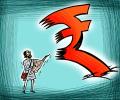
The rupee depreciated 22 paise to a record low of 78.59 against the US dollar in opening trade on Tuesday as persistent foreign funds outflows weighed on investor sentiments. At the interbank foreign exchange, the rupee opened on a weak note at 78.53 against the American dollar, then lost ground to quote at 78.59 -- its all-time low level, registering a fall of 22 paise from the last close. On Monday, the rupee declined by 4 paise to close at its life-time low of 78.37 against the US dollar.
Market sentiment suffered a jolt after other Asian markets closed with widespread losses and European markets dropped in early trade

Yes Bank was the top gainer in the Sensex pack, rallying up to 8.44 per cent, followed by Maruti, PowerGrid, NTPC, L&T and SBI.

In the Sensex kitty on Wednesday, Tata Motors emerged as the top loser falling 3.01 per cent, followed by Vedanta shedding 2.92 per cent. Other laggards include HUL, Kotak Bank, NTPC, Infosys, HDFC Bank, Bajaj Finance, Hero MotoCorp, ICICI Bank, Yes Bank, HDFC, IndusInd Bank and PowerGrid, falling up to 1.77 per cent.

Ola Electric share price strategy: The meteoric rise of Ola Electric share price has left analysts and investors bewildered. Yet, they suggest investors hold on to the stock as it remains a pure "momentum" play. Since its listing on August 9, the stock has surged 92 per cent (till August 19) over its issue price of Rs 76, taking its market capitalisation to a little over Rs 63,000 crore.

ICICI Bank, HDFC Bank, IndusInd Bank down between 0.2%-1.4% each.

HUL was the top gainer in the Sensex pack, rallying 5 per cent, followed by Kotak Bank, Nestle India, ICICI Bank, Mahindra and Mahindra, Asian Paints and RIL.
The S&P BSE Sensex ended the day at 28,226, up 85 points, while the Nifty50 settled at 8,734, up 18 points.
Market now awaits US jobs data for further direction on US Fed's stance on its QE.

Extending losses for 7th session, Nifty fell below the 8,000 mark for the first time since Nov 25

The rupee on Tuesday lost another 15 paise against the US dollar to close at 65.88

From the enactment of the capital control Act to the recognition of the BSE as a stock exchange and the infamous Harshad Mehta scam, here are the 18 biggest events for stock markets from 1947 to 1993.

Regardless of market levels, invest in stocks and equity mutual funds in a staggered manner.

'For experienced and risk-taking investors, now may be the time to go all in.' 'By 'experienced and risk-taking', I refer to those who remained net buyers in equities during the early stages of the 2020 pandemic.' 'On the other hand, those who exited the markets during the pandemic may go the SIP way.'

Markets ended in red; index heavyweight under pressure.

HSBC maintained "overweight" rating on Indian equities, saying "fundamentals are strong".

The sentiment got support from better-than-expected earning results by select companies and continuous buying by domestic financial institutions.

Inflation data, both at domestic and global level, interest rate scenario in the US, geopolitical situation and general elections in 2024 are some of the major factors that would influence trading in the equity market this financial year, analysts said. Besides, foreign fund trading activity and global trends will also dictate terms in the equity market going ahead. Equity markets across the globe faced major challenges in FY23 due to concerns over high inflation, which resulted in increase in interest rates around the world, lowering investor sentiment, experts added.

The breadth, indicating the overall health of the market, turned negative from positive

Sectorally, BSE metal, basic materials, energy, realty, power, oil and gas, finance, FMCG, bankex and telecom indices fell up to 1.71 per cent.

Top losers in the Sensex pack were Hero MotoCorp, HCL Tech, TCS, Asian Paints, IndusInd Bank and Infosys, shedding up to 3.08 per cent.

India Inc could be embarking upon a new phase of capital expenditure (capex) cycle, observed analysts, and suggest its revival would lead to a rerating of industrial stocks. Assisted by a property upcycle, analysts at Jefferies said several government initiatives were likely to drive capex. Indicators, they said, include a private project announcement at Rs 25 trillion for 2022-23 (up 150 per cent from pre-pandemic levels) and credit growth at about 16 per cent, which is closer to pre-pandemic highs.
